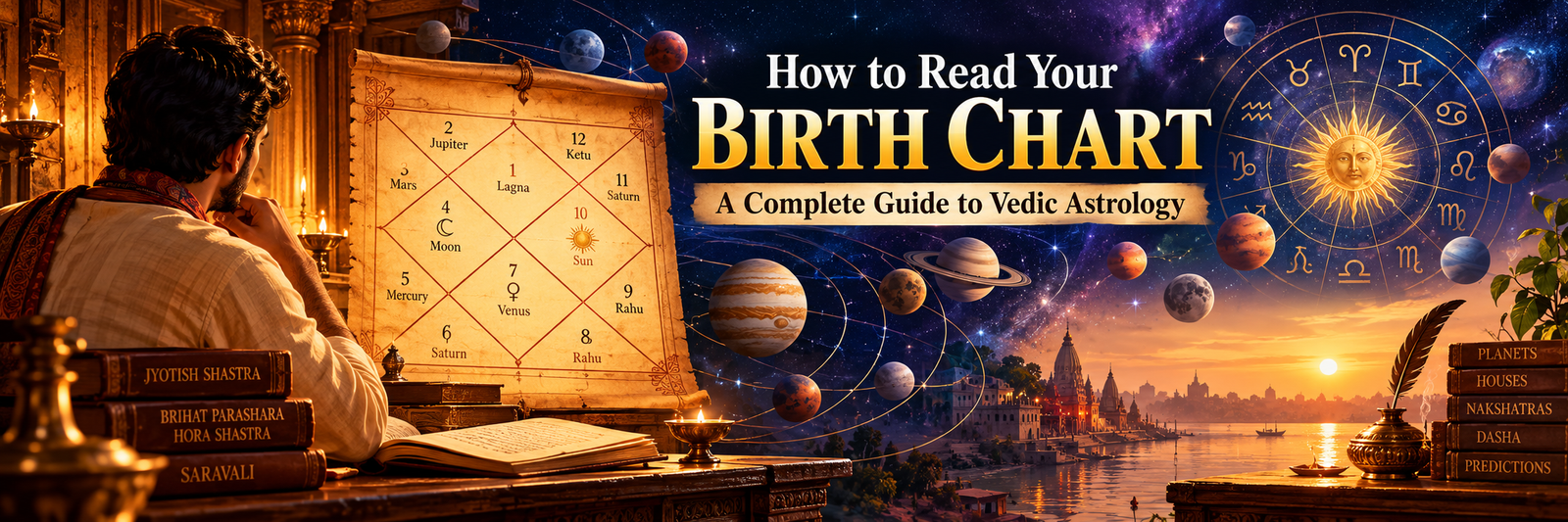
Have you ever wondered what your birth chart reveals about your personality, relationships, career, and life journey? In Vedic astrology, a birth chart, commonly known as a Janam Kundali or Janam Patri, is a traditional astrological map prepared using a person’s date, time, and place of birth.
Vedic astrology, also known as Jyotish Shastra, is an ancient Indian astrological tradition that studies the symbolic significance of planetary positions, zodiac signs, houses, and nakshatras. According to this tradition, examining these elements together helps astrologers interpret different aspects of an individual’s life.
A Vedic astrology birth chart is more detailed than a general daily horoscope based only on a Sun sign. It considers several interconnected factors to develop an individualised interpretation.
For those interested in understanding their horoscope, learning the basics of birth chart analysis can provide a useful introduction to the principles of Indian astrology.
What Information Is Needed to Prepare a Birth Chart?
Preparing a Janam Kundali generally requires three essential details.
1. Date of Birth
Your date of birth helps establish the planetary positions for the day you were born. It is one of the fundamental details used in calculating a birth chart.
2. Exact Time of Birth
The time of birth is particularly important for calculating the Ascendant, known in Vedic astrology as the Lagna. Even a relatively small difference in birth time can sometimes change the Ascendant degree or other chart details.
3. Place of Birth
The geographical location of birth helps determine the local astronomical calculations used to construct the horoscope.
When these details are accurate, an astrologer can prepare a more reliable chart for traditional astrological interpretation. If the birth time is uncertain, an astrologer may discuss whether birth time rectification or an alternative assessment method is appropriate.
Understanding the 12 Houses in Vedic Astrology
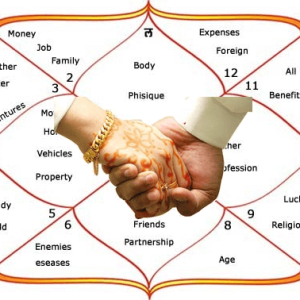
The twelve houses are among the most important components of a Vedic astrology birth chart. Each house represents particular areas of life in traditional astrological interpretation.
| House | Traditional Significance |
|---|---|
| First House | Personality, appearance, identity, and general outlook |
| Second House | Family, speech, accumulated wealth, and values |
| Third House | Communication, courage, skills, and siblings |
| Fourth House | Home, mother, emotional foundations, and property |
| Fifth House | Education, creativity, children, and intellectual interests |
| Sixth House | Work-related challenges, service, competition, and routines |
| Seventh House | Marriage, partnerships, and business relationships |
| Eighth House | Transformation, shared resources, and hidden matters |
| Ninth House | Philosophy, higher learning, fortune, and spiritual beliefs |
| Tenth House | Career, public reputation, and professional responsibilities |
| Eleventh House | Networks, aspirations, gains, and social connections |
| Twelfth House | Expenses, solitude, foreign connections, and spiritual reflection |
An astrologer does not generally interpret a house in isolation. Its ruling planet, the planets placed within it, planetary aspects, and the broader chart are considered together.
For example, career-related analysis may examine the tenth house, its ruler, Saturn, the Sun, relevant divisional charts, and planetary periods. The interpretation depends on the complete horoscope rather than one placement alone.
The Nine Planets in Vedic Astrology
Vedic astrology traditionally considers nine grahas, known as the Navagraha. These include the seven visible classical planetary bodies and the lunar nodes Rahu and Ketu.
Each graha carries particular symbolic meanings.
Sun (Surya): Associated with authority, confidence, leadership, vitality, and personal identity.
Moon (Chandra): Represents the mind, emotions, sensitivity, and mental patterns in traditional astrological interpretation.
Mars (Mangal): Associated with courage, initiative, energy, ambition, and assertiveness.
Mercury (Budh): Represents communication, reasoning, learning, calculation, and analytical ability.
Jupiter (Guru): Associated with wisdom, knowledge, teaching, expansion, and spiritual understanding.
Venus (Shukra): Represents relationships, affection, artistic interests, comfort, and material enjoyment.
Saturn (Shani): Associated with discipline, patience, responsibility, persistence, and long-term effort.
Rahu: Traditionally linked with ambition, unconventional pursuits, worldly desires, and unfamiliar experiences.
Ketu: Associated with detachment, introspection, renunciation, and spiritual inquiry.
These meanings are part of the interpretive framework of Jyotish Shastra. A planet’s significance depends on its placement, strength, house ownership, associations, and the rest of the birth chart.
Why Is the Ascendant (Lagna) Important?
The Ascendant, or Lagna, is the zodiac sign rising on the eastern horizon at the time and place of birth. It is a central reference point in many systems of Vedic astrology.
The Lagna determines the arrangement of the twelve houses in a standard birth chart and influences how an astrologer interprets the planets’ roles.
For instance, the same planet may rule different houses for people with different Ascendants. Consequently, its traditional interpretation can vary from one horoscope to another.
This is one reason why a personalised Kundli analysis is different from reading a general zodiac forecast.
What Is the Importance of Nakshatras?
Vedic astrology divides the zodiac into 27 principal nakshatras, or lunar mansions. Each nakshatra occupies a specific section of the zodiac and is associated with particular symbolic qualities.
Nakshatras are used in several traditional astrological practices, including:
- Understanding the Moon’s position at birth.
- Interpreting personality tendencies within an astrological framework.
- Examining traditional marriage compatibility factors.
- Calculating and interpreting Vimshottari Dasha planetary periods.
- Studying the symbolism of specific planetary placements.
The birth nakshatra is often determined from the Moon’s sidereal position. Its pada, or quarter, can provide further detail in traditional interpretation.
How Does Kundli Analysis Help With Career and Business Questions?
Career and business are among the common reasons people seek an astrology consultation.
In Vedic astrology, professional matters may be examined through the tenth house, its ruler, the sixth and eleventh houses, relevant planetary combinations, and the D10 divisional chart, also known as the Dashamsha.
An astrologer may interpret these factors in relation to traditional themes such as professional responsibilities, competition, leadership, income opportunities, and career transitions.
For business-related questions, the analysis may also consider partnerships, financial patterns, decision-making periods, and other relevant houses.
However, astrology should be treated as a traditional interpretive practice rather than a scientifically established method of predicting professional success. Important career and financial decisions should also be based on qualifications, practical experience, market research, and sound financial planning.
Marriage Compatibility and Kundli Matching
Marriage Kundli matching, also known as Kundli Milan, is a traditional practice used by many families when considering marriage.
The process commonly includes Ashtakoota matching, which compares eight compatibility factors based primarily on the Moon signs and birth nakshatras of two individuals. The traditional system assigns a maximum of 36 points.
Some astrologers also examine additional factors, including Mangal Dosha, planetary placements, the seventh house, Venus, Jupiter, and relevant divisional charts.
It is important to understand that a compatibility score alone cannot determine whether a marriage will succeed. Communication, mutual respect, shared expectations, emotional maturity, and consent are essential considerations that astrology cannot replace.
A thoughtful consultation should help individuals understand traditional astrological interpretations without creating unnecessary fear or pressure.
What Are Planetary Periods (Dasha) in Vedic Astrology?
Planetary periods, or Dashas, are used in Vedic astrology to interpret different phases of life.
One widely used system is Vimshottari Dasha, which follows a 120-year cycle divided among nine planetary rulers. The sequence and duration of the planetary periods are calculated using the Moon’s nakshatra at birth.
Astrologers may examine the Mahadasha, Antardasha, planetary placements, and relevant transits when interpreting a particular period.
For example, someone exploring a career transition may ask an astrologer to examine the planetary periods traditionally associated with professional matters. The resulting interpretation is an astrological perspective, not a guarantee that a particular event will occur.
Can You Consult an Astrologer Without Knowing Your Birth Time?
Many people do not know their exact time of birth. This can make certain aspects of conventional birth chart analysis more difficult, particularly those involving the Ascendant and house placements.
Depending on the circumstances, an astrologer may consider several approaches.
Birth time rectification: An astrologer attempts to assess a possible birth time using available information and significant life events. The result remains an interpretive estimate rather than a verified historical fact.
Moon sign and nakshatra analysis: Some aspects of a horoscope may be examined using available birth information, although the level of detail depends on what is known.
Alternative assessment methods: Some practitioners offer methods that do not require a conventional birth chart.
Dr. Sripati Tripathi’s website also features Astro X-Ray, a specialised astrology service presented as an alternative for people who may not have complete birth details. Interested readers can review the service information before deciding whether it suits their needs.
Explore the available options on the Astrology Services page.
How to Choose a Vedic Astrologer for a Personal Consultation
Choosing an astrologer is a personal decision. It is useful to look for someone who explains their approach clearly, listens carefully, and discusses the limitations of astrological interpretations.
Consider the following points before booking a consultation:
- Relevant experience: Review the astrologer’s background, practice, and areas of specialisation.
- Clear explanations: Choose a consultation where the reasoning behind an interpretation can be discussed.
- Personalised assessment: Share accurate birth details when available and explain the questions you want to explore.
- Responsible guidance: Be cautious of guaranteed predictions, fear-based claims, or pressure to purchase expensive remedies.
- Practical perspective: Use astrological interpretations as one perspective alongside informed, real-world decision-making.
A consultation should help you explore your questions thoughtfully, not make you feel that your future is beyond your control.
Consult Dr. Sripati Tripathi for Vedic Astrology Guidance
For readers interested in traditional Indian astrology, Dr. Sripati Tripathi offers astrology consultations through his website, including phone consultations, video consultations, and personal meetings.
The website lists services covering several areas of interest, including Janam Patri preparation, marriage compatibility, gemstone recommendations, child birth astrology, and Astro X-Ray.
Depending on your needs, you can explore the available services and select an appropriate consultation format.
Visit the official website: https://sripati.in/
You can also explore the Janam Patri and Kundli service to learn more about the available options.
For appointment enquiries, the website lists the following contact details:
- Phone/WhatsApp: +91 94306 69031
- Email: astrodrsripatitripathi@gmail.com
- Location: Patna, Bihar, India
Please confirm the current service details, availability, and consultation fees directly with the website before booking.
Frequently Asked Questions About Vedic Astrology
What is a Vedic astrology birth chart?
A Vedic astrology birth chart is a traditional diagram representing the positions of the nine grahas, zodiac signs, and houses calculated for a person’s birth date, time, and location. It is used by astrologers to interpret different aspects of life according to Jyotish principles.
Is a birth chart the same as a Kundli?
Yes. In common Indian usage, a birth chart, Janam Kundali, Janam Patri, and Kundli generally refer to the horoscope prepared using a person’s birth details, although chart formats and calculation conventions can vary.
Which details are required for Kundli analysis?
The usual requirements are date of birth, exact time of birth, and place of birth. These details help calculate the Ascendant, planetary placements, houses, and other chart factors.
Can astrology predict marriage and career?
Vedic astrologers interpret traditional chart factors to discuss marriage compatibility, career themes, and possible periods of change. These interpretations are not scientifically established guarantees of future events and should not replace practical decision-making.
Can I consult an astrologer online?
Yes. Online consultations can take place by phone or video call, depending on the astrologer’s available services. Dr. Sripati Tripathi’s website lists both phone and video consultation options.
What is the difference between a daily horoscope and a birth chart reading?
A daily horoscope generally offers a broad interpretation based on a zodiac sign or other simplified astrological factors. A birth chart reading considers individual birth details and multiple chart components, making it more personalised within the Vedic astrology framework.
Conclusion
A Vedic astrology birth chart brings together several traditional concepts, including the twelve houses, nine grahas, zodiac signs, nakshatras, and planetary periods. Understanding how these elements work together can help readers become familiar with the principles behind Janam Kundali analysis.
Whether you are curious about career-related interpretations, marriage compatibility, or the significance of planetary periods, begin by learning the fundamentals and asking clear questions.
For personalised guidance within the tradition of Jyotish Shastra, explore the astrology services offered by Dr. Sripati Tripathi at sripati.in.
Astrology can offer a cultural and spiritual framework for reflection, while thoughtful choices, personal responsibility, and practical action remain important parts of everyday life.