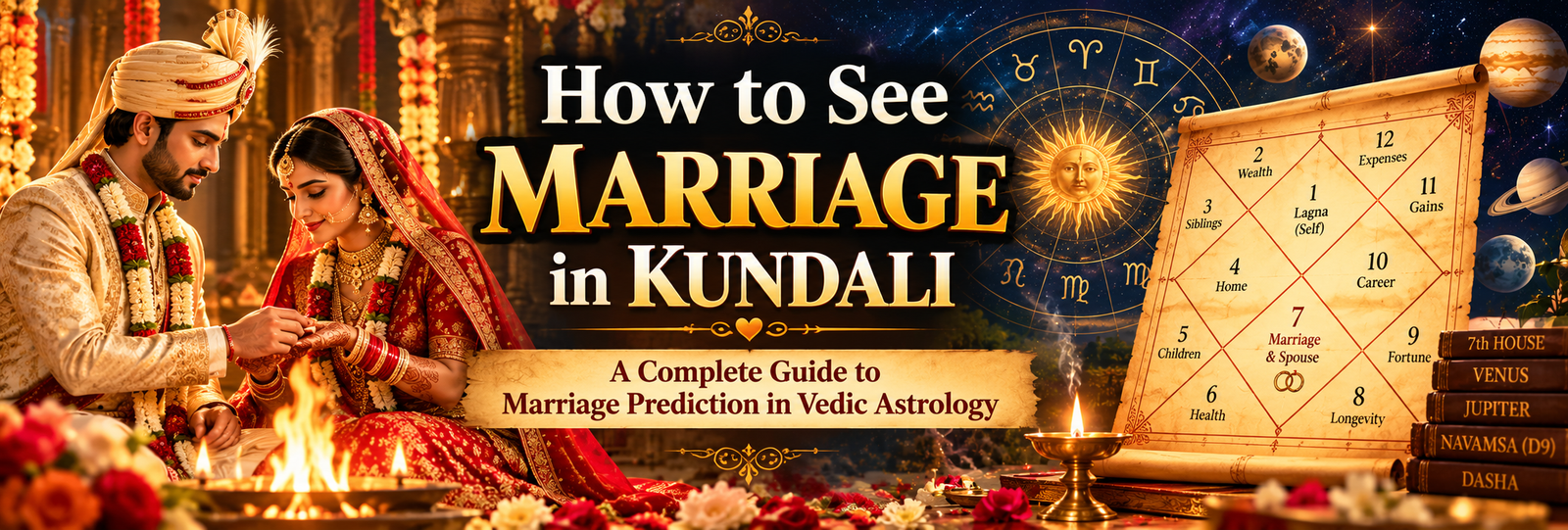
How to See Marriage in Kundali
Marriage is one of the most significant milestones in many people’s lives. Questions about when marriage may take place, what kind of life partner one might have, and whether a relationship may lead to marriage are common reasons people consult an astrologer.
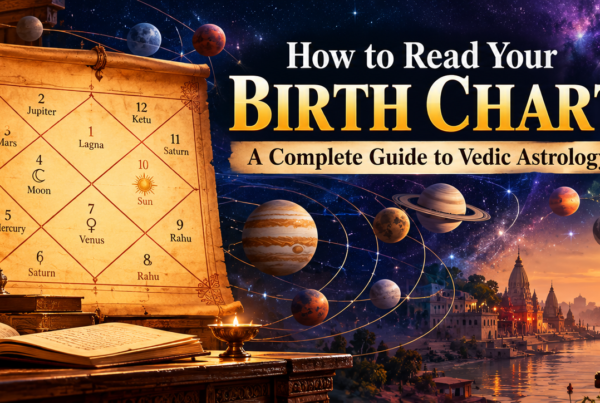
In Vedic astrology, marriage-related questions are traditionally examined through the birth chart, also known as Janam Kundali or Janam Patri. Astrologers study several factors, including the seventh house, its ruling planet, Venus, Jupiter, the Navamsa chart, and planetary periods known as Dashas.
However, marriage prediction is not based on a single planet or house. A proper interpretation considers the complete horoscope, the strength of relevant planets, planetary aspects, and the timing indicated by different astrological techniques.
In this guide, we explain how to see marriage in Kundali, which houses and planets are traditionally associated with marriage, and how astrologers approach marriage timing in Vedic astrology.
Consult Dr. Sripati Tripathi for Marriage Astrology Guidance
If you want to understand the marriage-related aspects of your birth chart, including the seventh house, marriage timing, Kundli matching, or Navamsa chart (D9), you can contact Dr. Sripati Tripathi for astrology consultation enquiries.
Through a personalised consultation, you can discuss your questions about marriage and explore the traditional principles of Vedic astrology relevant to your horoscope.
Contact Details
- Phone / WhatsApp: +91 94306 69031
- Email: astrodrsripatitripathi@gmail.com
- Location: Patna, Bihar, India
- Website: https://sripati.in/
To enquire about available consultation options, visit the official website or contact Dr. Sripati Tripathi directly.
1. The Seventh House: The Most Important House for Marriage
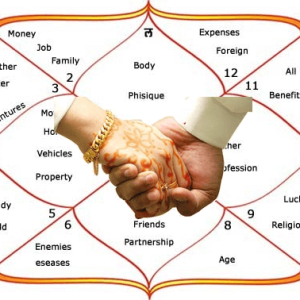
The seventh house is one of the principal houses examined when analysing marriage in Vedic astrology. It is traditionally associated with marriage, committed partnerships, spouse-related matters, and long-term relationships.
To understand marriage indications in a birth chart, astrologers generally examine the following factors.
The Sign in the Seventh House
The zodiac sign occupying the seventh house provides the starting point for traditional interpretation. Its characteristics and ruling planet are considered when assessing relationship patterns and partnership themes.
For example, an astrologer may interpret the seventh house differently depending on whether it falls in Aries, Taurus, Libra, Capricorn, or another zodiac sign.
The sign alone, however, cannot establish the timing or outcome of a marriage.
The Lord of the Seventh House
The planet ruling the seventh house is called the seventh-house lord or seventh lord. Its placement, dignity, strength, conjunctions, and aspects are important elements of marriage analysis.
An astrologer may examine whether the seventh lord is placed in a favourable sign, associated with benefic or challenging planets, or connected with other houses relevant to relationships.
The seventh lord’s placement in different houses is traditionally interpreted in different ways. These interpretations must be assessed within the complete chart rather than applied as fixed rules.
Planets in the Seventh House
The presence of planets in the seventh house can add further themes to the interpretation.
For instance, Venus in the seventh house is traditionally associated with relationship, affection, and partnership themes. Saturn may introduce themes of responsibility, patience, or delay in some interpretations, while Jupiter may be associated with wisdom, guidance, or supportive influences.
These are traditional astrological associations, not guaranteed descriptions of a person’s marriage. The dignity of the planets, their house ownership, aspects, and the wider horoscope all matter.
2. The Importance of Venus in Marriage Astrology
Venus, known as Shukra in Vedic astrology, is traditionally associated with love, attraction, romance, harmony, and marital relationships.
Astrologers examine Venus when assessing relationship preferences, romantic inclinations, and the significance of partnership in a person’s life.
The analysis may include:
- Venus’s zodiac sign and house placement.
- Its strength and dignity in the birth chart.
- Its conjunctions and planetary aspects.
- Its relationship with the seventh house and seventh lord.
- Its placement in the Navamsa chart.
- The planetary periods associated with Venus.
A well-supported Venus may traditionally be interpreted as a constructive influence on relationship matters. Challenging placements may prompt an astrologer to explore possible tensions or areas requiring patience and understanding.
It is important to avoid concluding that a particular Venus placement guarantees a happy marriage or that another placement necessarily causes marital difficulties.
3. What Is the Role of Jupiter in Marriage Prediction?
Jupiter, known as Guru or Brihaspati, is associated with wisdom, guidance, growth, and dharma in Vedic astrology.
In many traditional interpretations, Jupiter is given particular importance in analysing marriage in a woman’s horoscope. Venus is often examined as a relationship significator across horoscopes, while the seventh house and its lord remain central to the overall assessment.
A responsible marriage analysis does not rely exclusively on gender-based rules. It considers the full horoscope, including the seventh house, its lord, relevant planetary significators, and the Navamsa chart.
Astrologers may also examine Jupiter’s aspects, dignity, conjunctions, and Dasha periods when discussing marriage-related possibilities.
No single Jupiter placement can reliably establish whether or when a person will marry.
4. How to Check Marriage Timing in Kundali
One of the most frequently asked questions in astrology is, “When will I get married?”
In traditional Vedic astrology, marriage timing is assessed through a combination of planetary periods, house connections, and transits. It is not determined by one fixed formula.
Vimshottari Dasha and Marriage Timing
Vimshottari Dasha is a widely used planetary-period system in Vedic astrology. It divides the traditional 120-year cycle among nine planetary rulers.
During marriage analysis, astrologers may examine the Mahadasha and Antardasha of:
- The seventh-house lord.
- Planets placed in the seventh house.
- Venus, as a traditional relationship significator.
- Planets connected with the second house, which is associated with family.
- Planets connected with the fifth house, which is often examined in romance-related questions.
- Planets connected with the eleventh house, associated with fulfilment of desires and gains.
A planetary period connected with several marriage-related factors may be considered relevant to a possible marriage window.
However, the presence of a particular Dasha does not guarantee marriage during that period. The complete birth chart and other timing factors must also be considered.
The Role of Planetary Transits
Transits, known as Gochar, are another element of traditional marriage timing.
Astrologers may examine the transits of Jupiter and Saturn in relation to the seventh house, its lord, the Ascendant, and the Moon. Their connections with relevant natal placements may be used to identify periods considered astrologically significant.
Transit analysis is generally combined with Dasha analysis rather than treated as a standalone method.
Can Kundali Predict the Exact Marriage Date?
Vedic astrology practitioners may identify periods they consider more favourable for marriage, but identifying an exact date with certainty is not possible through a scientifically validated method.
A responsible astrologer should explain the basis of a traditional interpretation without presenting an estimated marriage window as an unavoidable event.
5. Why the Navamsa Chart (D9) Is Important for Marriage
The Navamsa chart, commonly called the D9 chart, is one of the most important divisional charts used in Vedic astrology.
It is traditionally examined alongside the main birth chart, known as the Rashi chart or D1 chart, to gain additional insight into marriage, partnership themes, and planetary strength.
What Do Astrologers Examine in the D9 Chart?
Common areas of examination include:
- The Navamsa Ascendant: Its sign, ruling planet, and overall condition.
- The Seventh House in D9: Its sign, occupants, and ruling planet.
- Venus in D9: Its placement, dignity, and associations.
- The Seventh Lord in D9: Its condition and relationship with other planets.
- Connections Between D1 and D9: Whether marriage-related factors in the main chart receive support or face challenges in the Navamsa chart.
Astrologers interpret these factors together rather than using the D9 chart as an independent prediction tool.
Accurate birth details are particularly important because the Ascendant and divisional chart placements can change with birth time.
6. How to Identify Love Marriage in Kundali
Another common question is whether a horoscope indicates love marriage or an arranged marriage.
In Vedic astrology, practitioners traditionally examine connections between houses associated with romance, marriage, and social networks.
Connection Between the Fifth and Seventh Houses
The fifth house is associated with romance, attraction, creativity, and personal interests, while the seventh house represents committed partnerships and marriage.
A relationship between the fifth and seventh houses, their lords, or planets influencing both houses may be interpreted as a possible indication of a romantic relationship developing into marriage.
The Role of Venus and Mars
Venus represents attraction and relationship themes, while Mars is associated with passion, initiative, and assertiveness.
Their placements and connections with the fifth or seventh house may be considered in traditional love-marriage analysis.
Rahu and Unconventional Relationships
Rahu is sometimes associated with unconventional choices, unfamiliar social environments, or relationships that differ from established family expectations.
When Rahu connects with the fifth or seventh house, some astrologers examine whether the chart symbolically reflects a nontraditional relationship path.
However, none of these placements can independently confirm a love marriage. Personal choices, family circumstances, cultural context, and the decisions of both partners remain important.
7. How to Check Arranged Marriage Indications in Kundali
Arranged marriage is also examined through the seventh house and other houses associated with family, relationships, and social connections.
The second house is traditionally associated with family and family continuity, while the seventh house represents marriage and committed partnerships.
Some astrologers also examine the fourth house in relation to domestic life and the eleventh house in relation to social networks and fulfilment of aspirations.
Connections among these houses may be interpreted within the broader context of family involvement in marriage.
Nevertheless, there is no single planetary combination that conclusively establishes whether a marriage will be arranged by family or initiated through a romantic relationship.
Love marriage and arranged marriage are not mutually exclusive categories in every situation. Many marriages involve both personal choice and family participation.
8. What Is Manglik Dosha, and Does It Affect Marriage?
Manglik Dosha, also known as Mangal Dosha or Kuja Dosha, is a traditional concept in Vedic astrology associated with the placement of Mars in certain houses of a birth chart.
Different astrological traditions use different rules when determining Manglik status. Some examine Mars in relation to the Ascendant, Moon, or Venus, while cancellation conditions and other modifying factors may also be considered.
In marriage matching, an astrologer may compare the charts of both prospective partners and assess the broader relationship factors rather than relying only on a Manglik label.
It is important not to assume that Manglik Dosha inevitably causes marital problems, separation, or harm to a spouse. Such outcomes are not scientifically established consequences of a planetary placement.
People considering marriage should prioritise mutual understanding, compatibility, consent, communication, and shared expectations.
9. Can a Kundali Reveal the Nature of Your Future Spouse?
Spouse-related interpretations traditionally consider the seventh house, its lord, planets influencing the seventh house, Venus, and the Navamsa chart.
Depending on the astrological tradition, these factors may be used to discuss symbolic themes concerning a future partner’s temperament, relationship preferences, or approach to commitment.
For example, some practitioners associate Jupiter with wisdom and guidance, Venus with affection and harmony, and Saturn with responsibility and patience.
These associations should not be treated as verified descriptions of a future spouse. A birth chart cannot reliably establish another person’s exact appearance, profession, personality, financial status, or identity.
The most useful approach is to treat such interpretations as part of a cultural or spiritual tradition rather than as a substitute for getting to know a prospective partner.
10. What If Your Marriage Is Getting Delayed?
People sometimes become concerned when marriage has not occurred by the age they expected.
In Vedic astrology, a practitioner may examine the seventh house, its lord, Saturn’s influence, Venus, the Navamsa chart, and relevant planetary periods when discussing a perceived marriage delay.
Certain combinations are traditionally interpreted as indicating patience, additional responsibilities, or a later marriage. However, these interpretations do not establish that a person will experience a delay or that a marriage is destined to be unsuccessful.
There are many practical reasons why marriage may happen later, including education, career priorities, personal preferences, financial circumstances, family responsibilities, and the search for a compatible partner.
A delayed marriage should not automatically be regarded as a defect in the horoscope. Nor should anyone feel pressured into marriage or expensive astrological remedies out of fear.
11. What Information Is Required for Marriage Prediction?
For a traditional marriage analysis, an astrologer generally needs the following information:
- Date of birth: To calculate the planetary positions for the birth date.
- Exact time of birth: To determine the Ascendant, houses, and divisional charts.
- Place of birth: To calculate the chart using the appropriate geographical coordinates and time zone.
- Specific question: Whether the concern relates to marriage timing, compatibility, love marriage, or another relationship matter.
If the birth time is unknown, some aspects of conventional horoscope analysis may be less precise. An astrologer may discuss alternative approaches, but any interpretation should acknowledge the limitations of incomplete birth information.
12. Should You Consult an Astrologer for Marriage Prediction?
Reading a Kundali online can introduce you to the basic concepts of marriage astrology. However, a detailed traditional interpretation involves assessing the interactions among houses, planetary rulers, aspects, divisional charts, and planetary periods.
If you choose to consult an astrologer, look for someone who explains their reasoning clearly and avoids guaranteed predictions, fear-based claims, or pressure to purchase costly remedies.
A consultation may help you understand the traditional astrological interpretation of your questions, but it should not determine your marriage decision for you.
For marriage-related decisions, astrology should remain a personal or cultural consideration alongside practical compatibility, mutual respect, informed choice, and open communication.
Frequently Asked Questions About Marriage in Kundali
1. Which house represents marriage in Kundali?
The seventh house is the primary house traditionally associated with marriage and committed partnerships in Vedic astrology. Its ruling planet, occupants, aspects, and connections with other houses are also examined.
2. Which planet is responsible for marriage?
No single planet is solely responsible for marriage. Astrologers commonly examine the seventh-house lord, Venus, Jupiter in relevant traditional contexts, and the planets influencing the seventh house, together with the Navamsa chart and planetary periods.
3. How can I know my marriage age through Kundali?
Vedic astrologers traditionally examine the seventh house, its lord, the D9 chart, Vimshottari Dasha, and relevant transits to discuss possible marriage periods. These methods cannot scientifically establish an exact marriage age.
4. Can Kundali predict love marriage?
Astrologers may interpret connections between the fifth and seventh houses, Venus, Mars, and Rahu as possible symbolic indications of romantic relationships leading to marriage. No planetary combination conclusively determines whether a person will have a love marriage.
5. Can a weak seventh house prevent marriage?
A seventh house considered weak under a particular astrological system does not prove that marriage will be prevented. The complete chart and the astrologer’s interpretive framework matter, and planetary placements should not be treated as scientifically established causes of marriage outcomes.
6. Is the Navamsa chart necessary for marriage prediction?
The Navamsa chart is widely used in traditional Vedic marriage analysis. It is generally interpreted alongside the main birth chart to assess additional marriage-related themes and planetary strength.
7. Does Manglik Dosha always cause marriage problems?
No scientifically reliable evidence establishes that Manglik Dosha causes marital problems. Even within Vedic astrology, practitioners may consider cancellation rules, chart context, and the horoscopes of both partners rather than relying on a single label.
8. Can I check marriage compatibility online?
Online tools can provide basic Kundli matching calculations based on the information entered. A detailed traditional interpretation may involve additional factors, while real relationship compatibility also depends on communication, values, respect, and shared expectations.
Conclusion: Understanding Marriage Through Vedic Astrology
Learning how to see marriage in Kundali begins with understanding the seventh house, its ruling planet, Venus, Jupiter, and the Navamsa chart. Astrologers may also examine Vimshottari Dasha and planetary transits when discussing traditional marriage timing.
However, a meaningful interpretation requires looking at the complete horoscope rather than drawing conclusions from a single planetary placement. No birth chart can guarantee an exact marriage date or conclusively determine the success of a relationship.
For readers interested in the traditional principles of Jyotish Shastra, consulting a knowledgeable practitioner may offer an opportunity to explore marriage-related questions from an astrological perspective.
Explore the astrology services of Dr. Sripati Tripathi at sripati.in to learn more about personalised horoscope consultations.
Ultimately, a healthy marriage depends not only on beliefs or predictions but also on mutual respect, understanding, trust, and the choices two people make together.